How to Measure Your Chest for a Shirt (With Photos)
Learn exactly how to measure your chest for a shirt in 3 steps — men, women, and kids. Includes inch/cm chart and common mistakes.
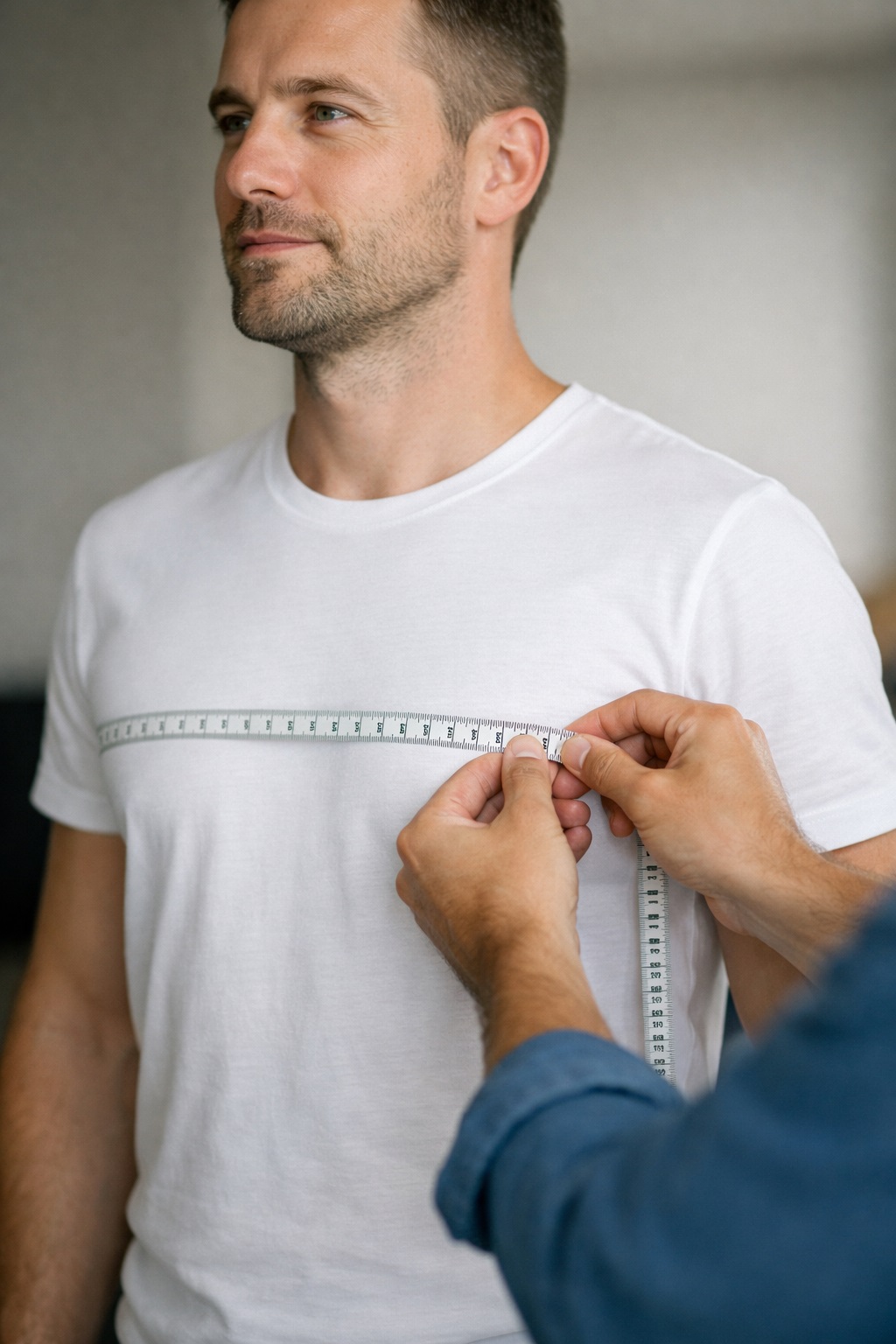
Chest measurement is the single number that determines whether a shirt fits or gets returned. Get it wrong by an inch and the shirt pulls across the back, gaps at the buttons, or swamps your shoulders. Get it right and everything else — sleeve length, shoulder width, overall silhouette — falls into place naturally.
The measurement itself takes about 90 seconds. Most people still get it wrong, usually because they're holding the tape too tight, measuring in the wrong place, or taking the measurement alone when they need someone to help. This guide covers all of it.
What You Need
- A soft measuring tape (the kind used for sewing — not a rigid builder's tape)
- A helper, if possible
- A mirror if you're measuring alone
- A notepad or your phone to record the number
No soft tape?
How to Measure Your Chest: Step by Step
Stand naturally
If you're wearing a shirt, keep it on — measure over a fitted base layer, not over a thick jumper or jacket. You want the tape around your body, not around your clothes.
Find the fullest point
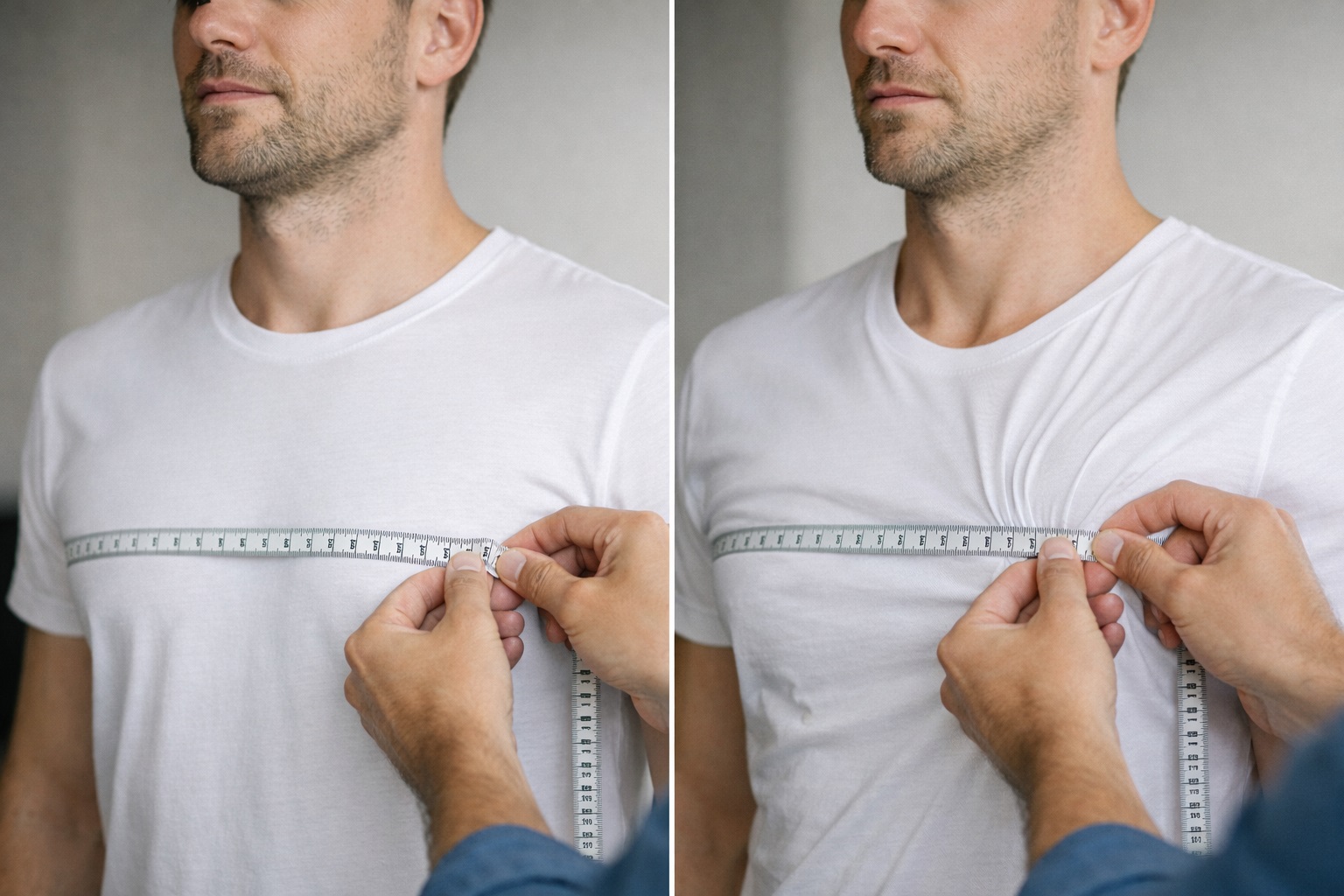
This is where most people go wrong. Measuring too high (across the upper chest, near the collarbone) gives a number that's smaller than your actual chest and leads to shirts that pull across the body. Too low and you'll get an inflated number and shirts that are loose where they should fit.
Wrap and read

Read the number where the tape meets itself at the front. If you're between measurements, round up to the nearest half-inch or centimetre.
That's your chest measurement.
Chest Measurement Chart — Men's Shirts
| Chest (inches) | Chest (cm) | US/UK Size | EU Size |
|---|---|---|---|
| 34–35" | 86–89 cm | XS | 44 |
| 36–37" | 91–94 cm | S | 46 |
| 38–39" | 96–99 cm | M | 48 |
| 40–41" | 101–104 cm | L | 50 |
| 42–43" | 107–109 cm | XL | 52 |
| 44–45" | 112–114 cm | XXL | 54 |
| 46–47" | 117–119 cm | 3XL | 56 |
| 48–50" | 122–127 cm | 4XL | 58–60 |
Body vs garment measurement
Chest Measurement Chart — Women's Shirts and Tops
| Bust/Chest (inches) | Bust/Chest (cm) | US Size | UK Size | EU Size |
|---|---|---|---|---|
| 32–33" | 81–84 cm | XS | 8 | 36 |
| 34–35" | 86–89 cm | S | 10 | 38 |
| 36–37" | 91–94 cm | M | 12 | 40 |
| 38–39" | 96–99 cm | L | 14 | 42 |
| 40–41" | 101–104 cm | XL | 16 | 44 |
| 42–43" | 107–109 cm | XXL | 18 | 46 |
| 44–45" | 112–114 cm | 3XL | 20 | 48 |
Women's sizing varies more than men's between brands. The chart above works as a starting point; always cross-reference with the specific brand's measurements before ordering.
Kids' Chest Measurement Guide
For children, chest measurement works the same way — fullest point of the chest, tape level and snug, two fingers of breathing room.
| Chest (inches) | Chest (cm) | Approximate Age | Height |
|---|---|---|---|
| 20–21" | 51–53 cm | 2–3 years | 92–98 cm |
| 22–23" | 56–58 cm | 4–5 years | 104–110 cm |
| 24–25" | 61–64 cm | 6–7 years | 116–122 cm |
| 26–27" | 66–69 cm | 8–9 years | 128–134 cm |
| 28–29" | 71–74 cm | 10–11 years | 140–146 cm |
| 30–31" | 76–79 cm | 12–13 years | 152–158 cm |
Kids' sizing by age is notoriously unreliable across brands — a size "8 years" from one brand can fit like a "10 years" from another. Chest circumference is a far more reliable basis for sizing children's shirts than age alone.
Common Mistakes (and What They Cost You)
Pulling the tape too tight
The most common one. People tighten the tape as if they're measuring something precise and rigid. Your chest isn't rigid. Pull it taut enough to lie flat against your body, not tight enough to compress the flesh underneath. A measurement taken too tight will result in shirts that are too small.
Measuring alone without a mirror
If the tape twists around your back — which it often does — you'll read an incorrect number. Either get someone to hold the tape in place at the back, or use a mirror to check alignment.
Measuring over thick layers
A thick hoodie or a padded jacket adds real inches. Measure over a fitted T-shirt or a lightweight base layer, or directly on skin.
Letting the tape drop at the back
The tape should be horizontal all the way around your body. If it dips down at the back, you're measuring a longer path than your actual chest circumference. The number will be larger than your real measurement and you'll end up in shirts that are too loose.
Confusing chest with bust
For women, some brands label the measurement "bust," some label it "chest." They typically refer to the same thing: the circumference at the fullest point. If a brand specifies both a "bust" and a "chest" measurement, bust usually refers to the circumference over the fullest point of the breasts, and chest refers to the circumference just below them. Read each brand's measurement guide to be sure.
Chest Measurement for Custom and Made-to-Measure Shirts
For off-the-rack shirts, your chest measurement maps you to a size. For custom or made-to-measure shirts, your chest measurement is one of several numbers that goes directly to a tailor or production team.
If you're ordering from a Shopify store that offers custom tailoring or made-to-measure shirts, you'll often be asked to enter your chest measurement directly — along with shoulder width, sleeve length, shirt length, and potentially neck size. These measurements together determine the final garment dimensions.
Some custom tailoring stores on Shopify use Tailor Size Guide to collect these measurements at checkout — a step-by-step guided form with diagrams that walks you through each measurement point before you add the shirt to your cart. If the store you're ordering from has this, use it: it's the most accurate way to ensure the finished garment matches your body.
How to Convert Between Inches and Centimetres
Multiply inches by 2.54 to get centimetres. Divide centimetres by 2.54 to get inches.
| Inches | Centimetres |
|---|---|
| 34" | 86.4 cm |
| 36" | 91.4 cm |
| 38" | 96.5 cm |
| 40" | 101.6 cm |
| 42" | 106.7 cm |
| 44" | 111.8 cm |
| 46" | 116.8 cm |
| 48" | 121.9 cm |
Most US and UK brands use inches. Most European brands use centimetres. When a European brand lists a chest measurement of "100 cm," that's equivalent to a 39.4" chest — mapping to a men's M or L in US/UK sizing.
When to Measure Again
Your chest measurement can change. Weight gain, weight loss, muscle development, or simply measuring incorrectly the first time — any of these will shift the number. If you're ordering from a new brand, or if your last measurement was more than six months ago, take it again before ordering.
For custom or made-to-measure garments specifically, always take a fresh measurement. A garment being made to your dimensions is only as accurate as the numbers you provide.
FAQs
Where exactly do I place the tape to measure my chest for a shirt?
Across the fullest point of your chest — typically at nipple height for men, across the fullest point of the bust for women. The tape should be level all the way around and snug but not tight.
Should I measure my chest with clothes on or off?
Measure over a thin, fitted base layer rather than directly on skin — you'll be wearing something under the shirt. Avoid measuring over anything thick like a jumper or jacket, as that adds significant inches to the reading.
My chest measurement falls between two sizes. Which should I choose?
Generally, size up. A shirt that's slightly too large can be tailored in. A shirt that's slightly too small cannot be let out. For fitted or slim-cut shirts specifically, sizing up one is usually the right call.
Why does my chest measurement not match the size on my current shirts?
Because garment sizing is inconsistent between brands and has changed over time. Your body measurement is the reliable constant. The label on a shirt is not. Always check a brand's specific size chart against your body measurement.
How do I measure my chest alone?
Wrap the tape around your chest at the fullest point and use a mirror to check that it's level at the back. Hold one end of the tape at the front where it meets itself and read the number. It helps to practise the position once before taking the actual reading.
What's the difference between chest measurement and shirt size?
Your chest measurement is a body measurement — the circumference of your chest in inches or centimetres. Your shirt size (S, M, L, or a numeric size) is a label that corresponds to a range of chest measurements. The relationship between the two varies by brand — always check the specific brand's size chart.
I'm ordering a custom-made shirt. Do I measure the same way?
Yes. The measurement method is the same — fullest point of the chest, tape level and snug. For a custom or made-to-measure shirt, you'll typically need several additional measurements alongside your chest: shoulder width, sleeve length, shirt length, and sometimes neck size. The store you're ordering from should specify exactly which measurements they need.
Selling made-to-measure shirts on Shopify?
Tailor Size Guide collects chest, shoulder, sleeve, and shirt-length measurements from your customers at checkout — with diagrams on every field.