By Mohit Patel, Marketing Specialist, Tailor Size Guide
US to Japan Clothing Size Conversion (JIS Standard Decoded)
A Japanese L often fits like a US M. JIS sizing runs 1–2 sizes smaller than US — but once you decode it, it's more honest than American sizing. Here's the chart, the cm system, and the brand-specific calibration.
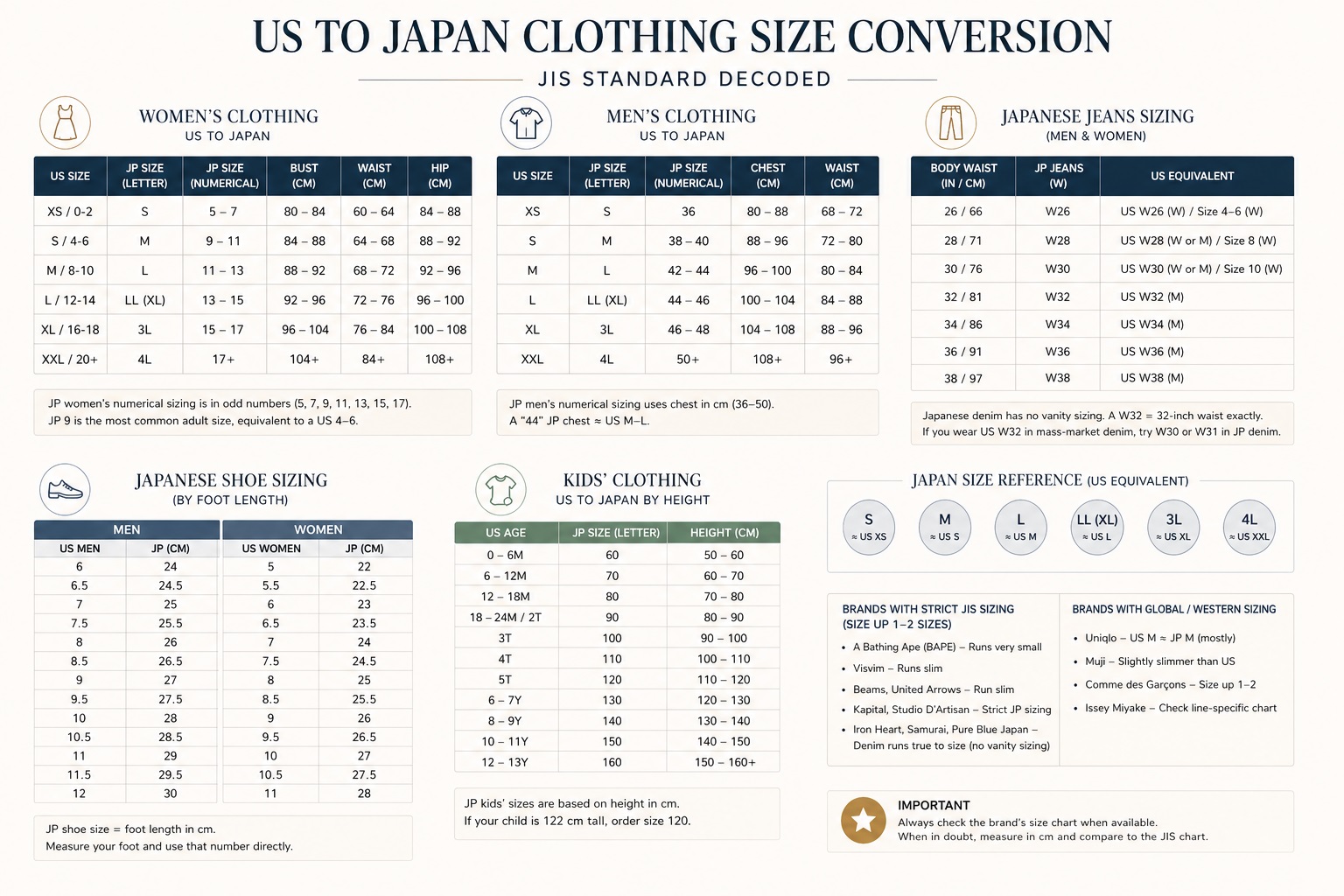
A Japanese L often fits like a US M. A Japanese XL fits like a US L. A Japanese XXL fits like a US XL. The labels say one thing, the bodies fit another, and most American shoppers buying Japanese brands online get burned the first time.
The trap: Japanese clothing is sized for the average Japanese body, which historically runs smaller and slimmer than the average American body. JIS (the Japanese Industrial Standard) was developed for that body shape and has not been recalibrated for export markets.
The fix: convert by body measurement, not by letter. Japanese clothing is sized in centimeters and follows JIS rules that, once decoded, are simpler and more accurate than US sizing.
This guide explains JIS, the 1-to-2-size shift between US and Japan, the cm-direct system that makes Japanese sizing more honest than American sizing once you understand it, and the brand-specific calibration for buying from popular Japanese labels online.
What JIS Sizing Actually Means
JIS stands for Japanese Industrial Standards. It's the official Japanese sizing standard, last updated in 1997.
JIS sizing is built around three dimensions:
- Bust or chest in cm
- Waist in cm
- Hip in cm
- Height in cm
Japanese sizes are labeled with letters (S, M, L, LL, 3L, 4L) or numerical sizes (7, 9, 11, 13, 15 for women), with each label corresponding to specific cm ranges.
JIS uses centimeters directly
Why Japanese Sizes Run 1 to 2 Smaller
The average Japanese woman is 5'2" (158 cm) with a 33-inch (84 cm) bust. The average American woman is 5'4" (162 cm) with a 36-inch (91 cm) bust.
JIS sizing is calibrated for the Japanese average. American shoppers ordering Japanese clothes by letter label routinely buy 1 to 2 sizes too small.
- Japanese S = US XS
- Japanese M = US S
- Japanese L = US M
- Japanese LL (XL) = US L
- Japanese 3L = US XL
- Japanese 4L = US XXL
This is true across most Japanese brands. There are exceptions (Uniqlo's global sizing follows international standards more closely), but the general rule is: order one to two sizes up from your US size.
US to Japan Women's Clothing Chart
| US Size | JP (Letter) | JP (Numerical) | Bust (cm) | Waist (cm) | Hip (cm) |
|---|---|---|---|---|---|
| XS / 0–2 | S | 5–7 | 80–84 | 60–64 | 84–88 |
| S / 4–6 | M | 9–11 | 84–88 | 64–68 | 88–92 |
| M / 8–10 | L | 11–13 | 88–92 | 68–72 | 92–96 |
| L / 12–14 | LL or XL | 13–15 | 92–96 | 72–76 | 96–100 |
| XL / 16–18 | 3L | 15–17 | 96–104 | 76–84 | 100–108 |
| XXL / 20+ | 4L | 17+ | 104+ | 84+ | 108+ |
Japanese women's numerical sizes are odd-only
US to Japan Men's Clothing Chart
| US Size | JP (Letter) | JP (Numerical) | Chest (cm) | Waist (cm) |
|---|---|---|---|---|
| XS | S | 36 | 80–88 | 68–72 |
| S | M | 38–40 | 88–96 | 72–80 |
| M | L | 42–44 | 96–100 | 80–84 |
| L | LL or XL | 44–46 | 100–104 | 84–88 |
| XL | 3L | 46–48 | 104–108 | 88–96 |
| XXL | 4L | 50+ | 108+ | 96+ |
Japanese men's numerical sizing uses chest in cm (36 to 50). A "size 44" Japanese men's shirt has a 44-cm chest measurement, which corresponds to a US M to L. Despite the "44" sounding huge, it's roughly a US M.
Japanese Jeans Sizing (Men and Women)
Japanese denim brands (Iron Heart, Samurai, Studio D'Artisan, Fullcount, Pure Blue Japan) typically use waist in inches with no L-number, similar to W-style sizing.
| Body Waist (in/cm) | JP Jeans (W) | US Equivalent |
|---|---|---|
| 26 / 66 cm | W26 | US W26 (W) / Size 4–6 (W) |
| 28 / 71 cm | W28 | US W28 (W or M) / Size 8 (W) |
| 30 / 76 cm | W30 | US W30 (W or M) / Size 10 (W) |
| 32 / 81 cm | W32 | US W32 (M) |
| 34 / 86 cm | W34 | US W34 (M) |
| 36 / 91 cm | W36 | US W36 (M) |
| 38 / 97 cm | W38 | US W38 (M) |
Japanese repro denim has no vanity sizing
Japanese Shoe Sizing
Japanese shoe sizing is the most useful international system because it uses foot length in centimeters directly.
| US Men | US Women | JP (cm) |
|---|---|---|
| 6 | 7.5 | 24 |
| 6.5 | 8 | 24.5 |
| 7 | 8.5 | 25 |
| 7.5 | 9 | 25.5 |
| 8 | 9.5 | 26 |
| 8.5 | 10 | 26.5 |
| 9 | 10.5 | 27 |
| 9.5 | 11 | 27.5 |
| 10 | 11.5 | 28 |
| 10.5 | 12 | 28.5 |
| 11 | — | 29 |
| 11.5 | — | 29.5 |
| 12 | — | 30 |
JP shoe size = foot length in cm
Kids' Clothing — JIS by Height
JIS kids' sizes are based on height in cm. If your child is 122 cm tall, order size 120.
| US Age | JP (Letter) | Height (cm) |
|---|---|---|
| 0–6M | 60 | 50–60 |
| 6–12M | 70 | 60–70 |
| 12–18M | 80 | 70–80 |
| 18–24M / 2T | 90 | 80–90 |
| 3T | 100 | 90–100 |
| 4T | 110 | 100–110 |
| 5T | 120 | 110–120 |
| 6–7Y | 130 | 120–130 |
| 8–9Y | 140 | 130–140 |
| 10–11Y | 150 | 140–150 |
| 12–13Y | 160 | 150–160+ |
How to Use the JIS System to Your Advantage
Once you know your body in cm, JIS sizing is straightforward.
Measure bust, waist, and hip in cm
Not inches — Japanese charts use cm.
Find the row in the JIS chart that matches your numbers
Read across all three.
Order the corresponding Japanese size
Letter or numerical, depending on how the brand labels.
JIS is more accurate than American sizing
Brand-Specific Calibration for Japanese Brands
Some Japanese brands export to the US and adjust their sizing. Others sell only domestically and run pure JIS.
Brands with Western sizing (export-friendly)
- Uniqlo: global sizing. US M ≈ JP M for most items. Some items still run slightly small. Read recent reviews.
- Muji: mostly Western sizing. Slightly slimmer than American mass-market. If between sizes, size up.
- Comme des Garçons: designer brand. Uses JP letter sizing. CdG L often fits US S to M. Always size up 1 to 2.
- Issey Miyake: designer. JP sizing with Western lines. Read each line's specific chart.
Brands with strict JIS sizing (size up significantly)
- A Bathing Ape (BAPE): runs very small. JP XL often fits US M. Size up 2.
- Visvim: runs slim. Size up 1.
- Beams, United Arrows: Japanese department store house lines. Run slim. Size up 1.
- Kapital, Studio D'Artisan, Pure Blue Japan: workwear/denim. Strict JP sizing. Size up.
- Iron Heart: heavy denim. True to label (fits an actual 32" waist at W32). Match body waist.
- Samurai Jeans, Fullcount, The Real McCoy's: repro denim. True to W label.
Streetwear and outdoor
- Snow Peak: outdoor brand. Western sizing for export markets. JP sizing for domestic.
- WTAPS: streetwear. JP sizing. Size up 1.
- Kapital: designer workwear. Strict JP sizing. Size up 1 to 2.
When in doubt, search "[brand name] sizing" + "true to size" or "Japanese sizing" for verified shopper feedback.
Five Mistakes That Wreck US-Japan Conversion
Buying by letter alone
A "L" varies wildly between Japanese brands. Use cm body measurements, not letters.
Forgetting that JP repro denim has no vanity sizing
American W32 ≠ Japanese W32. Match body waist for JP repro brands.
Assuming all Japanese brands export with adjusted sizing
Many don't. Always check whether the brand uses JIS or "international" sizing.
Ignoring height in JIS charts
Japanese sizing assumes Japanese-average height (158 cm women, 170 cm men). Tall Americans may need to size up additionally for length even when the bust/waist matches.
Trusting third-party seller charts
When buying through grey-market resellers, always confirm with the brand's official chart.
When to Size Up vs. Size Down
Default rule: size up 1 to 2 from your US size when buying Japanese brands.
Specific exceptions:
- Uniqlo and Muji: match your US size for most items. Confirm with the chart for fitted styles.
- Comme des Garçons: size up 1 to 2.
- BAPE, WTAPS, streetwear: size up 2.
- Repro denim (Iron Heart, Samurai, Fullcount): match your body waist exactly. No vanity to subtract.
- Designer outerwear (Visvim, Sacai): match the brand's chart precisely.
FAQs
Why is Japanese sizing so much smaller than US sizing?
JIS is calibrated for the average Japanese body, which runs smaller and slimmer than the American average. The numbers are honest for Japan but require adjustment for export.
Is Japanese sizing standardized?
Yes. JIS L 4006 (women's) and JIS L 4004 (men's) define the standard. Most Japanese brands follow it, with variations in cut.
Do all Japanese brands use cm?
Most do. Some export-friendly brands (Uniqlo, Muji) also publish letter sizes (S, M, L) that match Western expectations. Letter sizes from domestic-only brands typically follow JIS.
Should I order from a Japanese site directly?
Yes if you know your cm measurements. The chart on the brand's site will give you the exact size. Use a forwarding service (Tenso, Buyee) if the brand doesn't ship internationally.
What if I'm buying men's shirts and I'm 6'2"?
Add a height check. Japanese L assumes 170 cm (5'7") height. If you're significantly taller, the shirt may fit in chest but be short in length. Look for "tall" lines or order LL/3L for length even if chest is your normal size.
Why are Japanese women's numerical sizes only odd numbers?
JIS women's numerical sizing uses 5, 7, 9, 11, 13, 15, 17 — odd numbers only. Even numbers are not used in Japanese women's clothing. JP 9 is the most common adult size, equivalent to a US 4–6.
Save Your cm Measurements
Two key conversions handle Japanese shopping for life.
- All body measurements in cm (not just inches)
- Foot length in cm
Japanese sizing is built on the metric system. If your numbers are in cm, every Japanese brand's chart becomes a precise lookup. Stores running Tailor Size Guide let shoppers save their measurements in cm and reuse them across every product, with US/JP conversion built in.
Selling to Japan or sourcing from Japanese brands on Shopify?
International sizing is the silent reason cross-border returns happen. Tailor Size Guide adds smart US/JP conversion charts and cm-based body measurement forms to your product pages so customers in either country find their right fit on the first try.