By Mohit Patel, Marketing Specialist, Tailor Size Guide
Best Puffer Jacket Sizing Guide: Size Chart and Fit Tips
Found this guide useful? Share it with someone who needs it.
Add Tailor Size Guide as a preferred source on Google
The best puffer jacket size is the one that closes comfortably over the thickest layer you'll wear underneath without squashing the insulation, and without leaving so much space that warm air escapes every time you move. To find it, measure your chest over that layer, check the sleeve and length, and match the numbers to the brand's chart rather than your usual letter size.
A puffer keeps you warm by trapping still air in its fill. Too tight, and you flatten that fill and lose warmth. Too loose, and the jacket pumps warm air out like a bellows. This guide shows you how to land in between, with a size chart, a simple way to work out your own layering allowance, and what fill power, baffles and fit labels actually mean for the size you order.
Key takeaways
- Measure your chest over your thickest winter layer, not over a T-shirt.
- A puffer that's too tight compresses the fill; one that's too loose loses heat. Aim for room to layer, not extra room.
- Check sleeve length with your arms reaching forward and pick a length that suits how you'll wear it.
- Fill power measures loft, not warmth on its own. Fill weight matters just as much.
- Never buckle a child into a car seat over a puffy coat.
Why puffer sizing works differently
With most jackets, a slightly loose fit is just a style choice. With a puffer, fit changes how warm you are.
Down and synthetic insulation don't produce heat. They work by holding a thick layer of still air around your body, and still air is a poor conductor of heat. Two things undo that:
- Compression. If the jacket is tight across your back or shoulders, the fill is squashed flat where it presses on you. Flat fill holds less air, so you get cold patches exactly where the jacket is tightest.
- Air movement. If the jacket is very loose, every step and arm swing pushes warm air out through the hem, cuffs and neck and pulls cold air in. Outdoor designers call this the bellows effect.
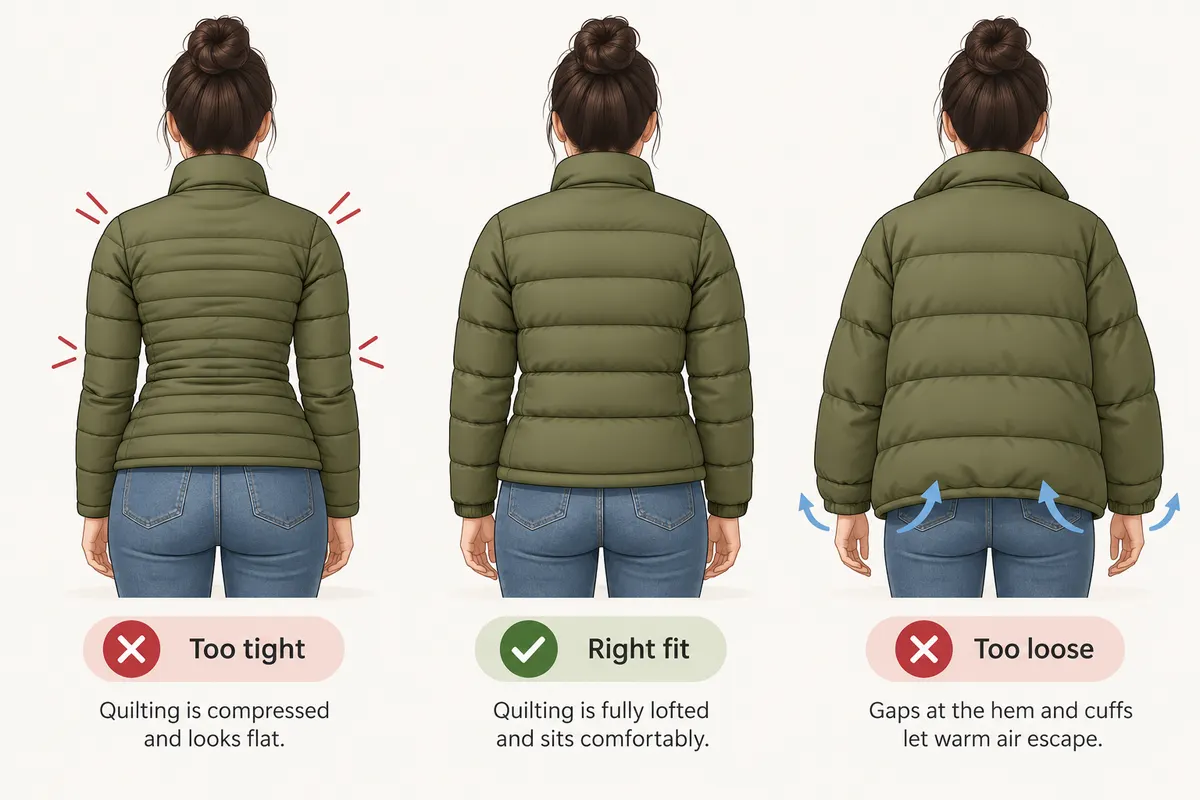
So the target isn't "as big as possible for layering" or "as fitted as possible for looks". It's a jacket that touches you lightly over your layers, with the fill fully lofted all the way round.
What to measure before you buy
You need a soft tape measure and the clothes you'll actually wear under the puffer. Our guide on how to measure for clothing online covers the basics if you're new to this.
Chest (or bust)
Put on your thickest usual midlayer: a fleece, a heavy sweater or a hoodie. Measure around the fullest part of your chest, under your arms and across your shoulder blades, keeping the tape level. This is the number to compare with the chart. Our guide on how to measure your chest shows the tape position step by step, and for women, see how to measure your bust.
Your layering allowance
Here's a trick that saves a lot of guessing. Measure your chest twice: once over a T-shirt, and once over the thickest layer you'll wear under the puffer. The difference is your layering allowance. A thin merino top might add almost nothing; a chunky fleece adds noticeably more.
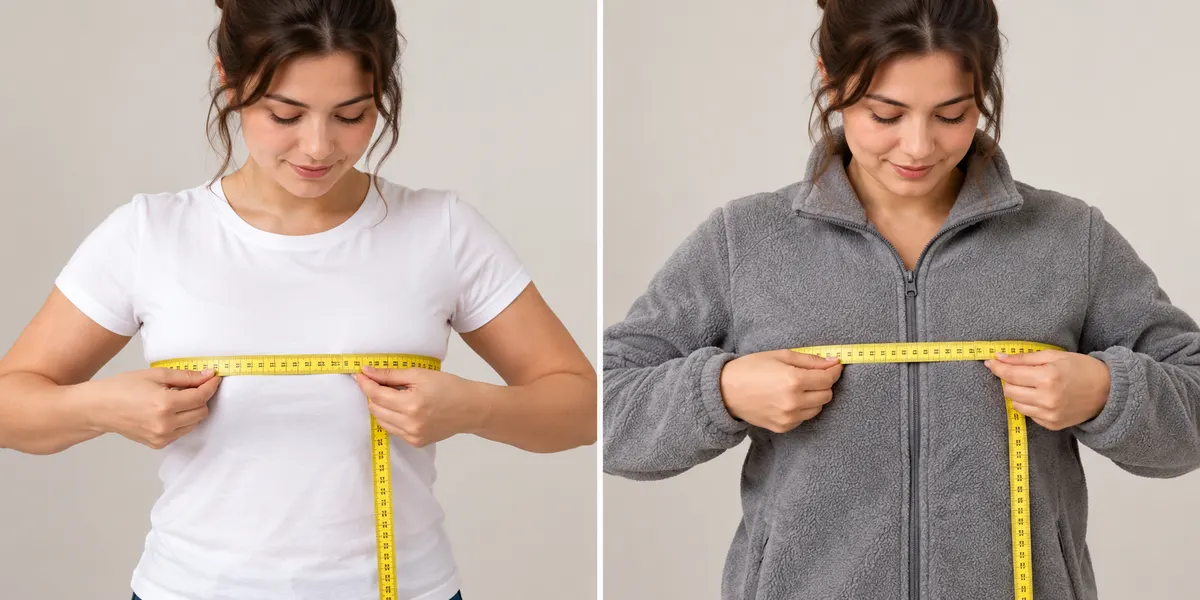
Knowing that number means you can use any brand's chart, even one that only lists body measurements: just add your allowance to your T-shirt measurement and size for the total.
Sleeve length
Measure from the centre back of your neck, across the top of your shoulder and down to your wrist bone, with your arm slightly bent. Puffer sleeves are thick, and the fill pulls the cuff back when you reach forward, so a sleeve that's exactly wrist length when your arm hangs will ride up when you drive or lift. Our guide on how to measure sleeve length has diagrams.
Length and hips
Decide where you want the hem to sit (more on that below), then measure from the base of your neck at the back down to that point. For anything that covers your hips, such as a longline puffer coat, also measure your hips at the widest point, because a long puffer that's fine at the chest can still pull across the hips when you sit. See how to measure your hips.
Shoulders
If you're broad across the back, check the shoulder width as well. A puffer that's tight at the shoulders is the most uncomfortable kind of tight, because you feel it every time you reach. Here's how to measure shoulder width.
Puffer jacket size chart
These are typical to-fit body measurements for men's and unisex puffers, in inches. "To fit" means the chest measurement of the person, not the jacket. Use your layered chest measurement.
| Size | Chest (body, in) | Back length (in) | Sleeve (in) |
|---|---|---|---|
| XS | 34 to 36 | 27 | 24.5 |
| S | 37 to 39 | 28 | 25 |
| M | 40 to 42 | 29 | 25.5 |
| L | 43 to 45 | 30 | 26 |
| XL | 46 to 48 | 31 | 26.5 |
| XXL | 49 to 51 | 32 | 27 |
Women's puffer size chart
Women's puffers are usually shaped through the waist, so bust, waist and hips all matter, especially for longer styles. These typical ranges match the chart on our women's clothing size calculator:
| Size | US | UK | Bust (in) | Waist (in) | Hips (in) |
|---|---|---|---|---|---|
| XS | 0 to 2 | 4 to 6 | 31 to 33 | 24 to 26 | 34 to 36 |
| S | 4 to 6 | 8 to 10 | 33 to 35 | 26 to 28 | 36 to 38 |
| M | 8 to 10 | 12 to 14 | 35 to 37 | 28 to 31 | 38 to 40 |
| L | 12 to 14 | 16 to 18 | 38 to 40 | 31 to 34 | 41 to 43 |
| XL | 16 to 18 | 20 to 22 | 41 to 43 | 34 to 37 | 44 to 46 |
| XXL | 20 to 22 | 24 to 26 | 44 to 46 | 37 to 40 | 47 to 49 |
Brands vary, sometimes by a whole size, so treat both charts as a starting point and the brand's own chart as the final word. If you're shopping across borders, our guide to US to UK sizes for clothes explains the conversions.
How to read a brand's size chart
Puffer size charts come in two kinds, and mixing them up is the most common reason people order the wrong size.
Body measurement charts tell you the size of the person each size is made for. Compare these with your own measurements (plus your layering allowance).
Garment measurement charts tell you the size of the jacket itself, often measured flat across the chest from armpit to armpit. If the chart says "pit to pit" or "flat", double it to get the jacket's full chest. The jacket's chest will always be larger than your body chest, and that difference is the room you've got inside, minus the thickness of the fill.
A worked example
Say you measure 39 inches over a T-shirt and 41 inches over your fleece, so your layering allowance is 2 inches.
- On a body chart, 41 falls in our size M (40 to 42). That's your size.
- If you measured only over a T-shirt, 39 would point you to an S, and the S would feel tight over the fleece. This is how most "runs small" reviews happen.
- On a garment chart listing a medium at 23 inches flat, the jacket's chest is 46 inches. That's 5 inches more than your layered chest, which leaves room for the fill to loft. Compare a couple of sizes this way and pick the one that gives you similar room in a jacket you already like.
That last tip is worth repeating: measure a jacket you already own and like the fit of, flat across the chest and down the back. It's the most reliable guide you have.
Choose the fit for how you'll wear it
A puffer for walking the dog and a puffer for a ski trip need different sizing. Decide what yours is for first:
| How you'll wear it | Fit to look for | Size for |
|---|---|---|
| Everyday city coat | Regular fit | Your chest over a sweater |
| Hiking and active use | Trim or athletic fit, so it doesn't bunch under a pack | Your chest over a thin fleece |
| Midlayer under a waterproof shell | Trim fit | Your base layer; then size the shell to fit over the puffer |
| Skiing and snowboarding | Regular fit with longer sleeves and a helmet-compatible hood | Your chest over ski layers |
| Oversized fashion puffer | Cut deliberately big | Your usual size; the extra room is designed in |
If you're buying a deliberately oversized style, don't size up as well. Designers have already added the room; sizing up just gives you sleeves past your fingertips. For ski-specific sizing, our ski jacket size chart and the guide to ski and snowboard apparel sizing go further.
Picking the right length
Length changes how warm a puffer is and how practical it is.
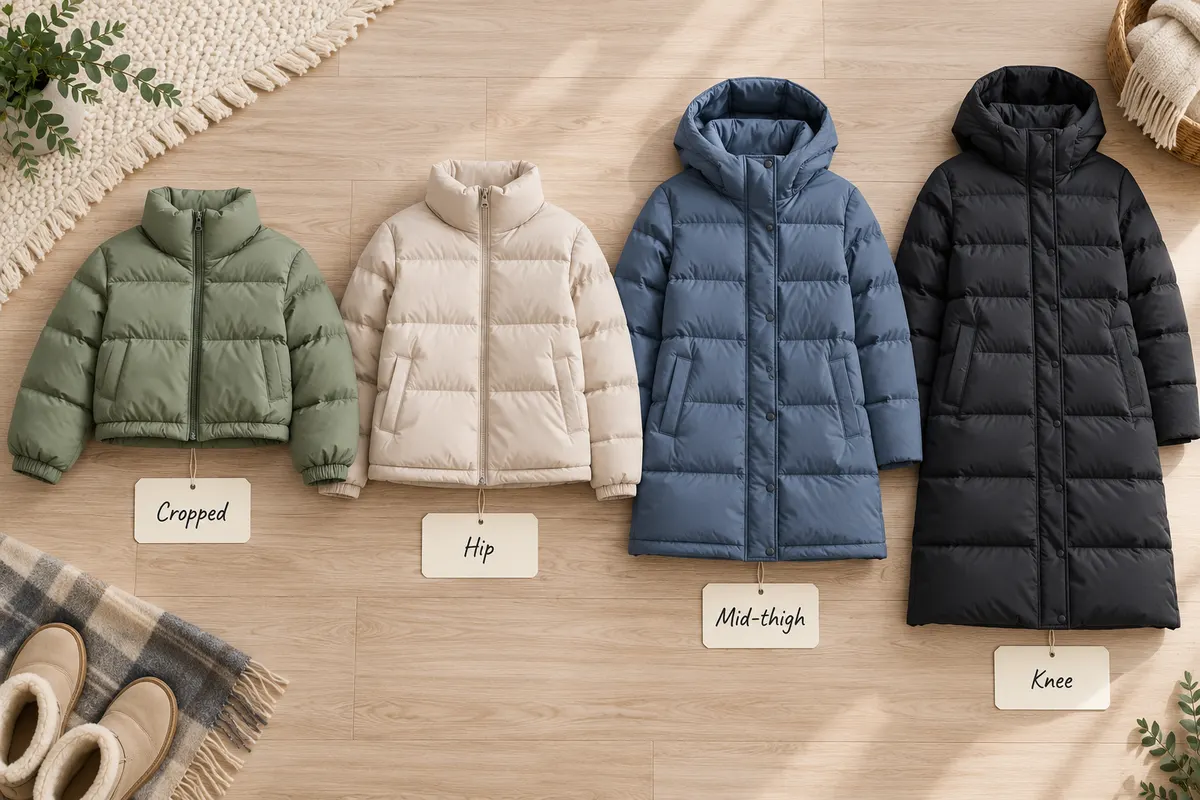
| Length | Where it sits | Good for | Watch for |
|---|---|---|---|
| Cropped | Waist | Style; layering with high-waisted trousers | Leaves your lower back exposed |
| Hip length | Top of the hips | Everyday wear, cycling, driving | Rides up when you bend unless the back is long |
| Mid-thigh | Mid-thigh | Cold commutes, waiting outside | Check you can sit and climb steps comfortably |
| Knee length or longer | Knee or below | The coldest climates | Needs a two-way zip or side vents to walk freely; check the hips |
For a longline puffer, measure your hips and make sure the chart covers them, and look for a two-way zip so you can open the bottom when you sit or drive. Our guide on how to measure for a winter parka covers long coats in more depth.
Sleeves, shoulders and hood
These are the parts that decide whether a puffer is comfortable all winter or annoying by December.
- Sleeves: with the jacket zipped, reach both arms forward as if holding a steering wheel. The cuffs should still cover your wrist bones. If you have long arms, look for "tall" sizes or styles with thumb loops or inner cuffs.
- Shoulders: cross your arms and hug yourself. You should feel the jacket move with you, not pull hard across your back.
- Hood: if you'll wear a helmet for skiing or cycling, check the hood says it's helmet compatible, and try it over the helmet if you can. A hood that's too small pulls the front zip down against your chin every time you turn your head.
Fill power, fill weight and what they mean for fit
Product pages for puffers are full of numbers. Here's what they mean, and how they relate to size.
Fill power
Fill power measures how much space a given weight of down takes up when it's fully lofted. It's stated in cubic inches per ounce: a down rated 800 fills 800 cubic inches per ounce in a standard lab test. Labs follow set methods, such as the IDFB Testing Regulations and the European EN 12130 method, and the down has to be conditioned before testing for the results to be comparable.
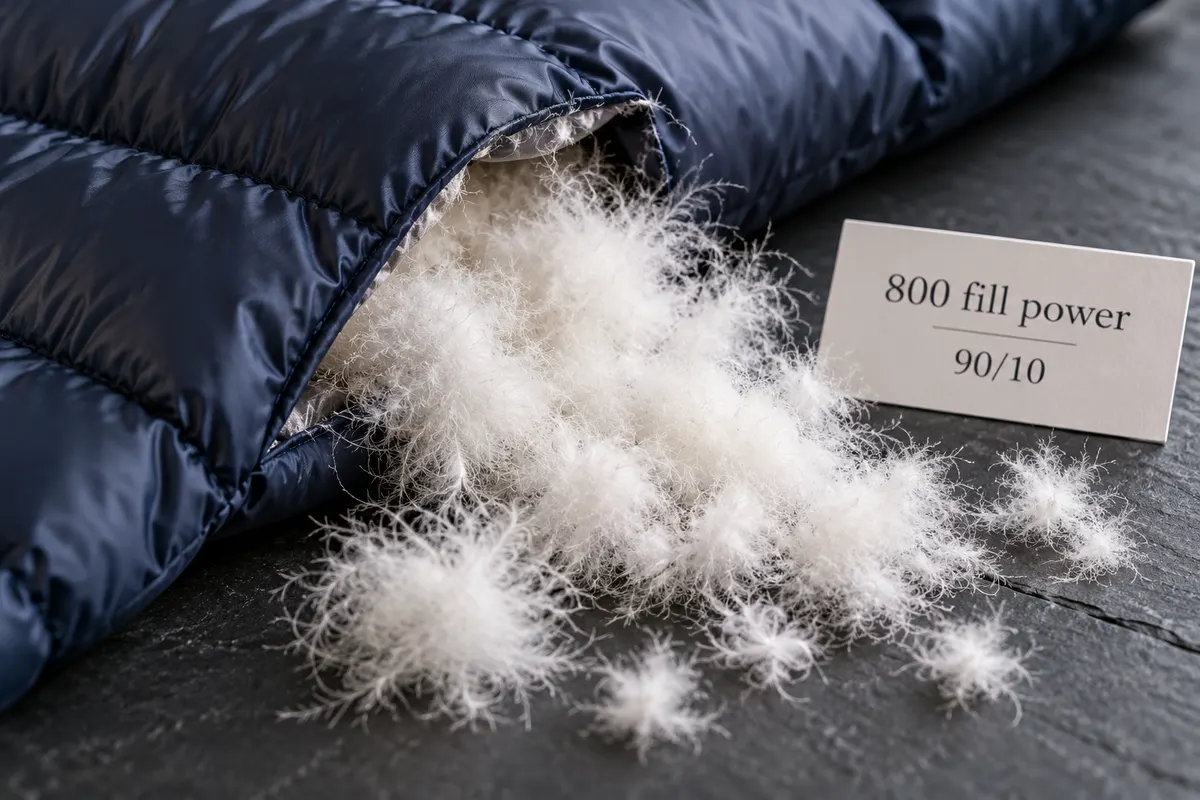
Higher fill power means the down lofts more for its weight, so a jacket can be as warm while being lighter and more packable. What fill power doesn't tell you on its own is how warm the jacket is. That depends on how much down is inside too.
Fill weight
Fill weight is how much insulation is in the jacket, in grams or ounces. A jacket with plenty of mid-range down can be warmer than one with a small amount of very high fill-power down. When a brand lists both, use both. When it lists only fill power, read it as a measure of quality, not warmth.
Why this matters for sizing
A heavily filled, high-loft jacket takes up more room on the inside when it's fully lofted, so the same size can feel snugger in a warmer model than in a thin one from the same brand. Two practical tips:
- If you're choosing between a thin and a thick version of the same jacket, try the thick one with your layers before deciding the size is the same.
- A puffer that has been squashed in a box or stuff sack needs time to loft. Shake it out and hang it for a few hours before judging the fit.
Down labels
Down products are often labelled with a ratio such as 90/10, meaning about 90% down and 10% feathers by weight. In Europe, the standard EN 12934 sets out how the down and feather content of a finished product should be labelled. More down and fewer feathers generally means a lighter, loftier fill.
Down or synthetic?
Down gives the most warmth for its weight and packs small, but it loses much of its loft when it gets wet. Synthetic fill keeps more of its insulation when damp and dries faster, though it's usually a little bulkier for the same warmth. For wet, mild winters a synthetic puffer can be the better buy; for dry cold, down is hard to beat. Either way, size the same way: over your layers.
If animal welfare matters to you, look for the Responsible Down Standard (RDS). It's run by the non-profit Textile Exchange, bans live plucking and force-feeding, and uses independent audits along the supply chain.
Baffles
The stitched sections that hold the fill in place are called baffles. Sewn-through baffles are stitched straight through the outer and inner fabric, which is light and simple but leaves thinner, colder lines along the seams. Box baffles add a fabric wall between the layers so the fill stays thick at the seams, which is warmer but heavier. Narrow baffles give a slimmer look; wide baffles look puffier and hold more fill.
The at-home try-on test
When your puffer arrives, keep the tags on and run through this before deciding to keep it:
- Put on your thickest usual layer and zip the jacket all the way up.
- Hug yourself. It shouldn't pull hard across your back.
- Reach forward as if driving. Your wrists should stay covered.
- Raise both arms above your head. The hem shouldn't lift far above your waist.
- Sit down. A longer puffer shouldn't strain across the hips or bunch up to your chest.
- Check the collar with the zip up. It should close without pressing on your throat.
- Walk around the house for a few minutes. If you feel a draught up the back, the hem or cuffs may be too loose.
If it passes all seven, it's the right size. If it fails one, try the next size or a different cut before you remove the tags.
Sizing puffers for children
Children's puffers are usually sold by age, with a height guide. Match the height rather than the age, as children of the same age vary a lot. Our kids' clothing size chart and kids' clothing size calculator help.
Buying one size up to allow for growth is common and fine, but not more than one size: sleeves that cover the hands and a hem that sits at the knees make it hard to play and let cold air in.
One safety point matters more than fit. The American Academy of Pediatrics advises that children shouldn't wear bulky coats or snowsuits under a car seat harness. In a crash the padding flattens, leaving the harness too loose to hold the child. Take the puffer off, buckle the harness snugly, then put the coat on backwards over the straps or tuck a blanket over them. The AAP's pinch test helps: if you can pinch a fold of harness strap at the shoulder, it's too loose.
Care that keeps the fit
A puffer that loses its loft also loses its fit, because it feels flatter and looser over time. A few habits help:
- Wash it rarely and gently, following the care label. Use a cleaner made for down if it's a down jacket.
- Dry it fully, on low heat with a couple of clean tennis or dryer balls to break up clumps. Damp down clumps and can go musty.
- Store it loose, hanging or folded loosely, not squashed in its stuff sack all summer.
Common puffer sizing mistakes
- Measuring over a T-shirt and then wearing the jacket over a fleece.
- Sizing up "for warmth". Past a point, extra room makes you colder, not warmer.
- Sizing up an oversized style, which already has the room built in.
- Ignoring sleeve length, then finding the cuffs ride up when you reach.
- Comparing a garment measurement with a body measurement without allowing for the difference.
- Judging the fit before the jacket has lofted after being packed.
- Assuming every brand runs the same. Read the reviews for "runs small" or "runs large" comments and check the brand's chart. Sizing drifts between brands, a habit known as vanity sizing.
Related size guides
If you're comparing outerwear, these guides help too: the jacket size calculator, the coat size calculator, the bomber jacket size chart, the trench coat size chart, the snowboard outerwear size chart and the motorcycle jacket size chart. To keep all your measurements in one place, try the body measurement calculator.
For shops selling puffer jackets
If you sell outerwear online, most puffer returns come down to the layering question. A size chart that shows both the body measurements and the garment measurements, with a note on how much room to allow for layers, answers it before the customer orders. Our free size chart generator builds one, and Tailor Size Guide for Shopify adds size charts and a free size recommender to every product page.
Frequently asked questions
Should I size up in a puffer jacket?
Usually not. Measure your chest over the thickest layer you'll wear underneath and buy the size that fits that measurement. Only size up if the brand says the style runs slim or your layered measurement falls at the top of a size. Sizing up for warmth often backfires, because a very loose puffer lets warm air escape.
How should a puffer jacket fit?
It should zip up comfortably over your usual winter layer, let you hug yourself and reach forward without pulling across the back, cover your wrists when your arms are stretched forward, and not leave a big gap at the hem or cuffs.
How do I measure for a puffer jacket?
Measure around the fullest part of your chest while wearing your thickest usual midlayer, then measure your sleeve from the centre back of your neck to your wrist, and your preferred back length. For long puffers, measure your hips too. Compare these with the brand's chart.
Do puffer jackets run small?
Some do. Trim and athletic cuts are often designed to go under a shell, so they feel small over a thick sweater. Most complaints come from people who measured over a T-shirt. Measure over your layers and check whether the chart lists body or garment measurements.
What does fill power mean on a puffer jacket?
Fill power is how much space an ounce of down fills in a lab test, in cubic inches. Higher numbers mean loftier, lighter down. It measures quality rather than total warmth, which also depends on how much down the jacket contains (the fill weight).
Can a puffer jacket be too big?
Yes. A very loose puffer moves warm air out each time you move and lets cold air in at the hem and cuffs, so it can feel colder than a jacket that fits closely over your layers. Oversized styles are designed with extra room, so buy those in your usual size.
Can my child wear a puffer coat in a car seat?
No. The American Academy of Pediatrics advises against bulky coats or snowsuits under a car seat harness, because the padding compresses in a crash and leaves the harness too loose. Buckle the child in without the coat, then lay the coat or a blanket over the straps.
Sources and standards
- REI Expert Advice: What is down fill power?Explains fill power and why it isn't the same as warmth.
- IDFL: Conditioning methods evaluationDown testing laboratory on how down is conditioned before fill power testing.
- IDFL: European labeling standardsSummary of EN 12934 composition labelling for down and feather products.
- Textile Exchange: Quick Guide to the Responsible Down StandardThe RDS bans live plucking and force-feeding and requires third-party certification.
- American Academy of Pediatrics, HealthyChildren.org: Winter car seat safety tipsAdvice against bulky coats under car seat harnesses, and the pinch test.
Put the right size chart on every product
Tailor Size Guide adds per-product size charts, a cm/inch toggle, and a fit recommender to Shopify product pages, with no theme code.